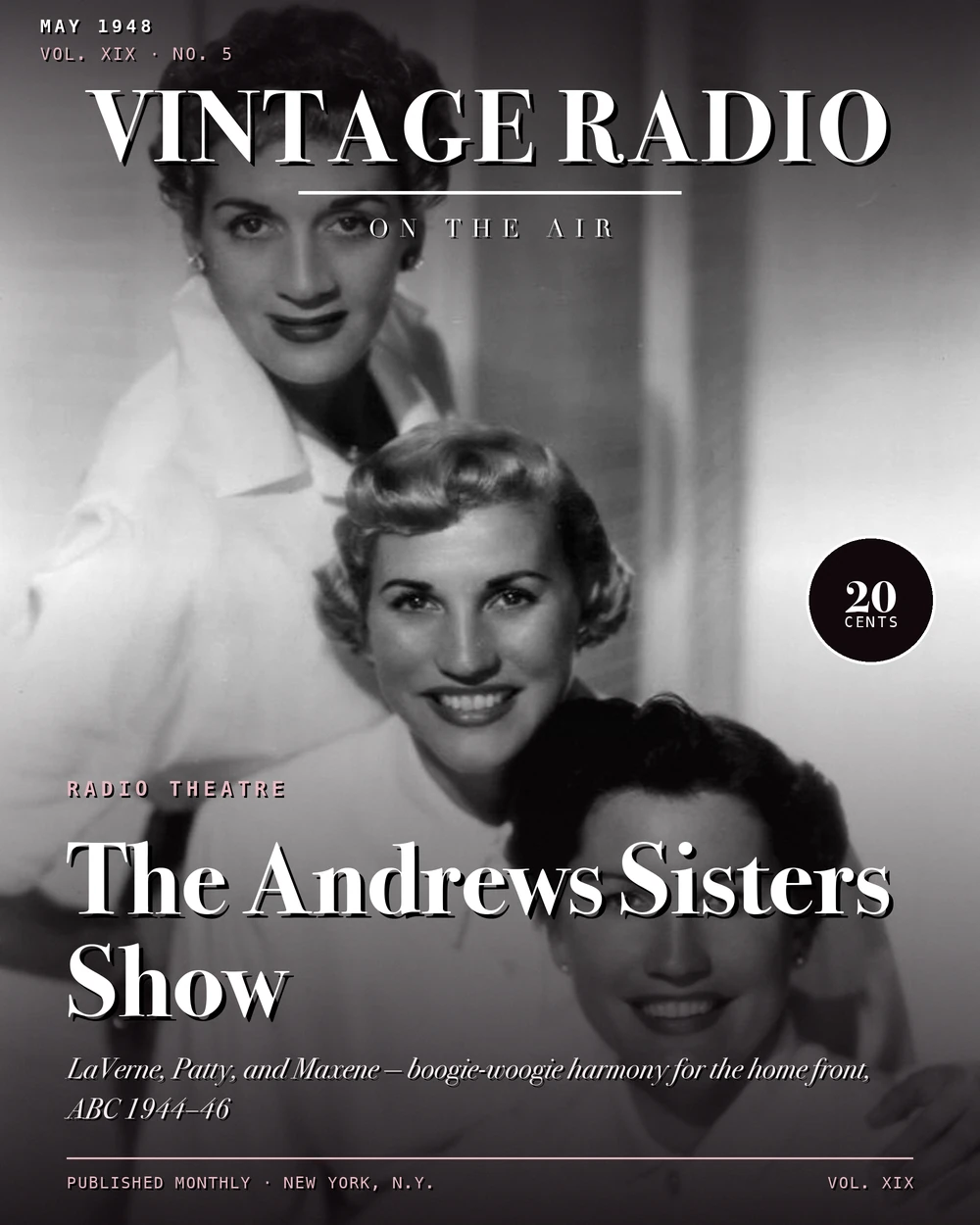
The Andrews Sisters Show
How Three Girls from Minneapolis Got Here
By the time LaVerne, Maxene, and Patti Andrews stepped into their own ABC radio series in late 1944, they had already spent the better part of a decade becoming unavoidable. Radio Life magazine summed it up plainly in 1941: "You'd have to be a hermit to escape them." That wasn't an exaggeration. Daughters of a Greek immigrant restaurant owner and his Norwegian-born wife, the sisters had been working professionally since their first engagement at Minneapolis's Orpheum Theatre in December 1932, then toured the South and Midwest with a small band through the Depression years, nearly ready to quit after six discouraging years on the road before a single recording changed everything.
That recording was "Bei Mir Bist Du Schoen," a Yiddish folk song their new manager Lou Levy had brought to songwriter Sammy Cahn, who fitted it with English lyrics. The Andrews Sisters cut it for Decca for a flat fee of fifty dollars. It went to the top of the pop charts and became the first record by a girl trio to break a million in sales. From that moment the sisters' trajectory was essentially unstoppable — signed by CBS for the Dole Pineapple show, featured alongside Glenn Miller on his Chesterfield quarter-hour broadcasts in 1939, frequent guests on programs hosted by Fred Allen and Bing Crosby. By 1941 they had logged an estimated 700 hours on the air. When Nash-Kelvinator came along wanting a vehicle for their Norge appliance line, a dedicated Andrews Sisters series was the logical next step.
The Eight-to-the-Bar Ranch Years
The show launched on New Year's Eve, 1944, broadcasting on ABC on Sunday afternoons at 4:30 — a half-hour of musical variety built around the sisters and a supporting cast that leaned hard into western flavor. The first season went out under the title "The Andrews Sisters' Eight-to-the-Bar Ranch," a nod to the boogie-woogie rhythm — eight beats per bar — that the sisters had popularized through hits like "Beat Me Daddy, Eight to the Bar." The fictional premise had them inheriting the ranch from their "Uncle Ed Andrews," required to operate it themselves as a condition of the bequest. The regular lineup fit the conceit: country singer Curt Massey and the Ambassadors, western harmony group Foy Willing and the Riders of the Purple Sage, and character actor George "Gabby" Hayes, familiar to audiences as a perennial sidekick in western B-pictures. André Baruch handled the announcing — a CBS staff veteran whose résumé already included Your Hit Parade, The Shadow, and The Kate Smith Hour — and Vic Schoen, the sisters' longtime arranger and musical director, provided the music.
The western trappings were essentially a frame on which to hang what the Andrews Sisters did naturally — tight three-part harmonies with Patti's mezzo-soprano lead, Maxene's high soprano harmony, and LaVerne's contralto underneath. Schoen, who had first met the trio in 1936 while playing trumpet in a society orchestra at New York's Edison Hotel, was entirely self-taught as an arranger, which suited a group in which most of the members couldn't read music. He'd already arranged "Bei Mir Bist Du Schoen" back in 1938 and would later say the first draft of "Boogie Woogie Bugle Boy" had been "a total mess" with "bad harmonies" and "wrong notes" before he reworked it and played the iconic opening trumpet solo himself. Surviving Eight-to-the-Bar broadcasts preserve live performances of songs the sisters never cut in the studio, including "I'm Beginning To See The Light," "The Trolley Song," and "Saturday Night Is The Loneliest Night of the Week."
The N-K Musical Showroom
When the second season opened in October 1945, the format shifted considerably. The western cast was dropped, the show moved to Wednesdays at 10:30, and the title became "The N-K Musical Showroom" — a name that signaled the new approach directly. Rather than a fixed supporting ensemble, each week brought a top guest star who would step out of the fictional "N-K Green Room" and perform whatever they were best known for.
The range of guests reflected how broadly connected the Andrews Sisters were across the entertainment world. Sophie Tucker appeared to sing "One of These Days." Abbott and Costello came on and ran through their "Who's on First?" routine — a particularly natural pairing, since the sisters had appeared with the comedy team in three Universal pictures back in 1941. Nash-Kelvinator stayed on as sponsor, so the show maintained a consistent commercial relationship across both formats even as the programming shifted around it. The Musical Showroom ran through March 27, 1946, when the network series ended, though the sisters' radio work continued in other forms — Wikipedia notes ABC and CBS shows running through 1951, with the sisters cutting jingles for everyone from Campbell's soups to Franco-American foods.
What the Show Represented
The Andrews Sisters' radio series arrived at an interesting moment — the tail end of World War II and the months immediately after, when popular entertainment was both a genuine comfort and a commercial industry operating at full speed. The sisters had built much of their wartime profile through hits like "Rhumboogie," "Beer Barrel Polka," and "Rum and Coca-Cola," and through extended tours entertaining Allied forces in Africa and Italy. They had sold 30 million records by 1944, and that year only Bing Crosby outsold them. Having their own half-hour on ABC was less a debut than a consolidation of an act that had already been everywhere.
The show's two-season arc — from the informal ranch setting to the more polished guest-star showcase — tracked something real about how radio production worked. Formats were fluid and sponsors had opinions. Nash-Kelvinator got a more prestigious-sounding property in the Musical Showroom, and the sisters got to share the stage with performers at the top of the business.
After the Run
The act dissolved after World War II, though "dissolved" oversimplifies a longer unwinding. Tensions surfaced in the 1950s when Patti decided to break away as a soloist, her pianist husband Walter Weschler having become the group's manager and pushed for a larger share. LaVerne and Maxene learned of the split from newspaper gossip columns rather than from Patti herself, and the bitter separation lasted two years before a 1956 reconciliation. The trio recorded for Capitol and then Dot through the 1960s without commercial success. LaVerne retired from performing due to illness in the fall of 1966 and died of cancer on May 8, 1967; the sisters made their final appearance as a trio in July 1968. Maxene later taught at a small college in Lake Tahoe, formed an organization to help wayward children and drug addicts, and in 1974 returned to the stage with Patti in the Broadway musical Over Here!, the top-grossing production of that season. She died on October 21, 1995. Patti, the last surviving sister, died in January 2013, two weeks shy of her ninety-fifth birthday.
The radio series itself was a relatively brief chapter in a much longer story — roughly fifteen months of weekly broadcasts sandwiched between years of recording and touring on one side and decades of gradual unwinding on the other. But as a document of the Andrews Sisters at the height of their popularity, the show captures something the recordings alone don't quite convey: the casual confidence of three performers who had genuinely earned their place at the center of American popular music.